Museums, Murals, and Memories: Connecting Past and Present along US Route 6
Every road tells a story, but few highways tell the story of America quite like US Route 6. Stretching from the Atlantic shores of Massachusetts to the Pacific coast of California, this historic roadway has carried generations of travelers through small towns, industrial centers, farming communities, mountain passes, and coastal villages. Along the way, museums, murals, and preserved landmarks serve as living bridges between yesterday and today, reminding visitors that the road itself is far more than pavement. It is a corridor of memory.
Traveling US Route 6 offers something increasingly rare in the modern world: the chance to experience history where it happened. Rather than viewing the past through a textbook, travelers encounter it firsthand in restored buildings, carefully curated museums, and public art that celebrates local identity. Each stop adds another layer to the story of America and the communities that have grown beside this great highway.
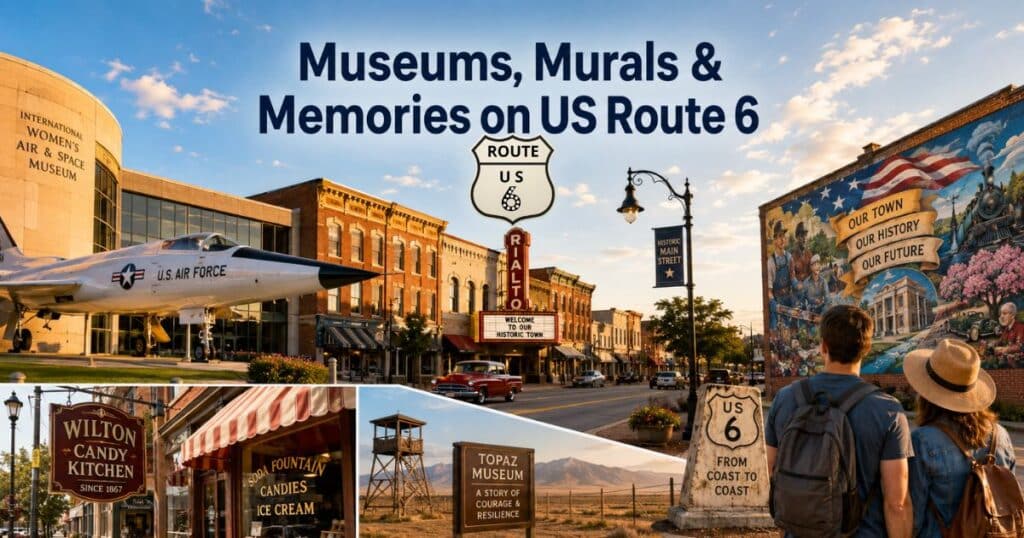
In Cleveland, Ohio, the International Women’s Air & Space Museum preserves the remarkable achievements of women who helped shape aviation and aerospace history. Located at Burke Lakefront Airport, the museum brings to life the stories of pioneering pilots, engineers, astronauts, and innovators whose contributions transformed flight and exploration. Visitors stand among artifacts and exhibits that connect early aviation dreams to the technologies that continue to push humanity toward new frontiers. The museum demonstrates how preserving history is not simply about honoring the past but also about inspiring future generations.
Further west in Iowa, the Wilton Candy Kitchen stands as a sweet reminder of a disappearing era. Established in the nineteenth century and still operating today, it preserves traditions that have endured through changing times. Walking through its doors feels like stepping into another century. The aroma of handmade candy, the historic soda fountain, and the original fixtures create an atmosphere that links modern visitors with countless travelers who stopped there long before interstate highways dominated American travel. Places like the Wilton Candy Kitchen demonstrate that preservation is not limited to grand museums. Sometimes it lives in the simple act of continuing a tradition.
In Utah, the Topaz Museum tells a more sobering story. Through exhibits documenting the experiences of Japanese Americans incarcerated during World War II, visitors encounter a chapter of American history that remains deeply relevant. The museum preserves artifacts, photographs, and personal accounts that ensure these stories are neither forgotten nor repeated. By connecting visitors with the experiences of those who lived through extraordinary circumstances, the museum transforms history into something personal and immediate.
Beyond museums, murals have become some of the most visible expressions of community identity along US Route 6. Across towns large and small, colorful public art transforms walls into open-air galleries. These murals often celebrate local industries, historical events, military service, cultural heritage, and notable residents. They tell stories that might otherwise disappear as generations pass. A mural depicting railroad workers, farmers, miners, or veterans becomes a visual reminder that every community contributed to the larger American story.
Murals also serve an important role in connecting younger generations with local history. While a museum exhibit may require a visitor to step inside a building, a mural invites curiosity from anyone passing by. Travelers pause for photographs, children ask questions, and conversations begin. In this way, public art becomes an accessible gateway to deeper historical exploration.
Historic downtown districts provide another connection between past and present. Throughout the US Route 6 corridor, restored storefronts, theaters, hotels, and public buildings continue to serve their communities while preserving architectural character. Walking these streets offers a glimpse into how towns developed during the golden age of highway travel. Many communities have embraced preservation not as a way of freezing history in time, but as a means of keeping it relevant and economically viable.
This blending of preservation and progress is one of the most fascinating aspects of US Route 6. The highway itself has changed dramatically since its designation in 1926. Routes have shifted, businesses have come and gone, and transportation technology has evolved. Yet the museums, murals, and landmarks that remain continue to tell the stories of those changes. They reveal how communities adapted while maintaining a connection to their heritage.
Perhaps the greatest lesson these sites offer is that history is not confined to the past. Every visitor who walks through a museum, photographs a mural, or explores a preserved landmark becomes part of the continuing story. Preservation is not simply about protecting old objects or buildings. It is about creating opportunities for future generations to understand where they came from and how their communities were shaped.
US Route 6 remains relevant today because it offers more than a route between destinations. It provides a journey through the layers of American history. Museums preserve the artifacts and stories that define our shared heritage. Murals transform public spaces into visual narratives. Historic landmarks stand as tangible reminders of the people and events that shaped the nation. Together, they connect past and present in ways that enrich every mile of the journey.
For travelers seeking more than scenic views, US Route 6 offers an invitation to slow down and explore. The next museum, mural, or preserved landmark may reveal a story you’ve never heard before, yet one that somehow feels familiar. Along this historic highway, history is not hidden behind glass. It lives in the communities, traditions, and memories that continue to thrive today.
The next time you travel US Route 6, take a moment to step inside a museum, linger before a mural, or explore a preserved landmark. You may discover that the most memorable part of the journey is not where the road leads, but the stories it shares along the way.
Subscribe today and let Route 6 come to you, one story at a time.